
Worm tablets, also called deworming tablets or anthelmintics, are medicines that kill or remove parasitic worms living in your intestines. Most people need only one dose or a short course, and the right tablet depends on which worm you have.
If you have noticed itching, stomach pain, or a child who is tired and underweight, this guide explains what worm tablets do, which kinds exist, and how to use them safely.
You may also have seen fenbendazole mentioned online. It is a worm medicine made for animals, and later sections explain why it is not a safe substitute for human worm tablets.
What Are Worm Tablets?
Worm tablets are prescription or pharmacy medicines designed to treat infections caused by intestinal parasites. They paralyze, starve, or kill the worms, and your body then passes them out in stool.
Intestinal worm infections are very common worldwide. The World Health Organization estimates that more than 1.5 billion people are infected with soil-transmitted worms, mostly in areas with limited sanitation.
How Worm Infections Spread
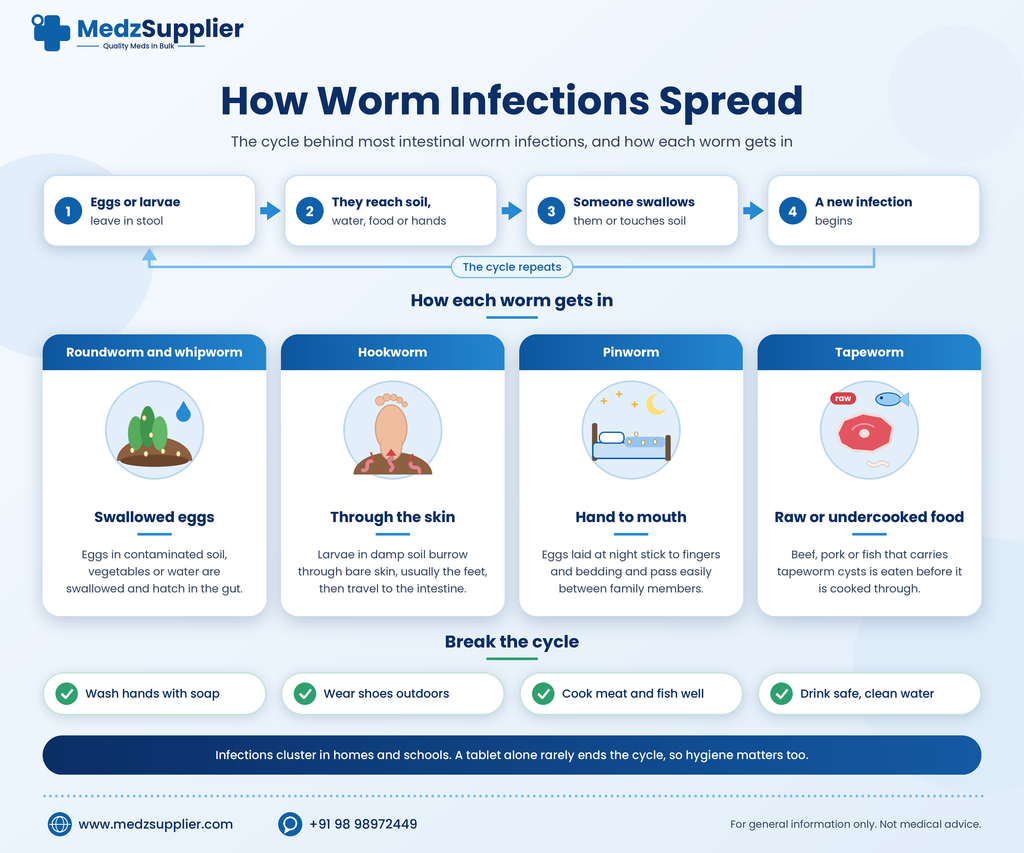
Most intestinal worms follow the same basic cycle. An infected person passes eggs or larvae in stool. Where toilets are missing or hand washing is poor, those eggs reach soil, water, food, or hands. Someone else then swallows them, or in the case of hookworm, the larvae burrow through bare skin.
The route depends on the worm:
- Roundworm and whipworm: eggs in contaminated soil, vegetables, or water are swallowed and hatch in the gut.
- Hookworm: larvae in damp soil enter through the skin of the feet, then travel to the intestine.
- Pinworm: eggs are laid around the anus at night, stick to fingers and bedding, and pass easily between family members, classmates, and playmates.
- Tapeworm: a person eats beef, pork, or fish that carries tapeworm cysts and was not cooked through.
This is why infections cluster in households, schools, and crowded communities, and why a tablet alone rarely ends the problem. Children are hit hardest because they play in soil, put their hands in their mouths, and are less consistent with hand washing. Anyone can be infected, though. Pinworm, for example, is common even in clean, well-off homes.
Common Types of Worm Tablets
| Medicine | Commonly used for |
| Albendazole Tablet | Roundworm, hookworm, whipworm, some tapeworms |
| Mebendazole Tablet | Pinworm, roundworm, whipworm, hookworm |
| Ivermectin Tablet | Threadworm (strongyloidiasis), scabies, river blindness |
| Praziquantel Tablet | Tapeworm and fluke infections (schistosomiasis) |
| Pyrantel pamoate | Pinworm and roundworm |
No single tablet kills every worm. That is why a doctor or pharmacist should match the medicine to the infection.
Types of Intestinal Worms
- Roundworm: Spreads through soil or food contaminated with eggs. It can cause belly pain and poor appetite.
- Hookworm: Enters through bare skin, usually the feet. It can cause blood loss and anaemia.
- Whipworm: Lives in the large intestine and can cause diarrhoea.
- Pinworm: Very common in children. It causes night-time itching around the anus.
- Tapeworm: Usually comes from undercooked meat or fish.
Symptoms That May Mean You Have Worms
- Itching around the anus, especially at night
- Stomach pain, bloating, or gas
- Loose stools or diarrhoea
- Weight loss despite eating normally
- Tiredness or pale skin (a sign of anaemia)
- Visible worms or segments in stool
- Poor sleep and irritability in children
Many people have no symptoms at all, so testing matters.
How Doctors Diagnose Worm Infections
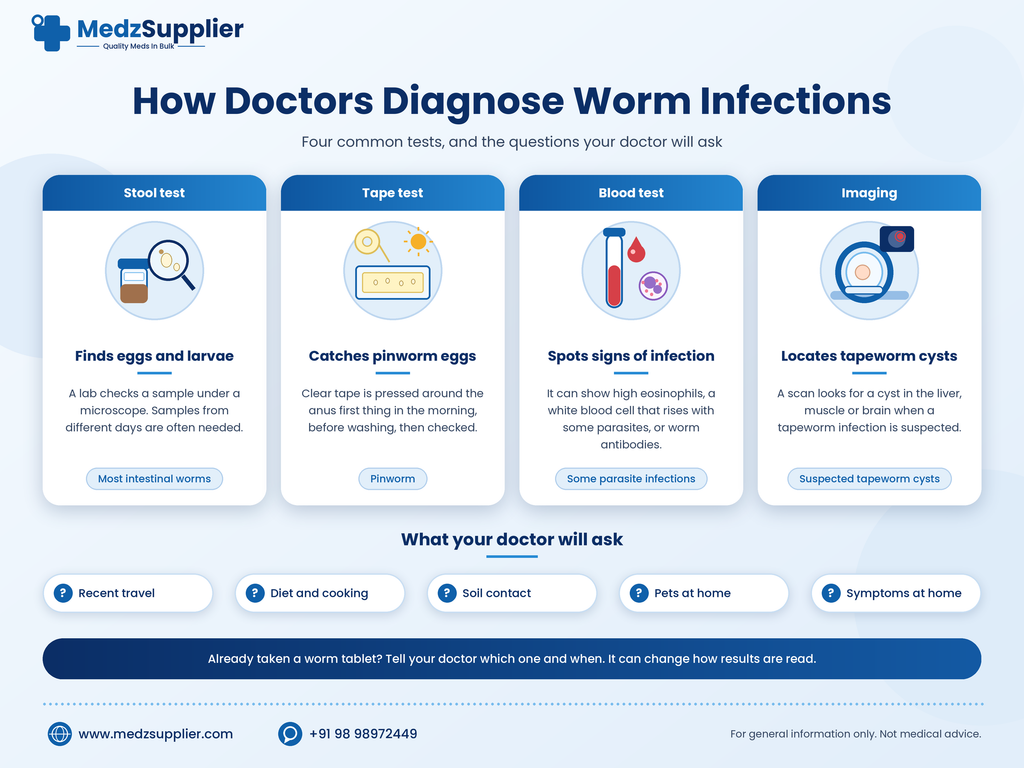
A correct diagnosis helps you get the right tablet the first time. The test depends on the suspected worm.
- Stool test (ova and parasite exam): a lab looks for worm eggs or larvae under a microscope. Doctors often ask for samples from different days, because worms do not shed eggs every day.
- Tape test for pinworm: clear tape is pressed against the skin around the anus first thing in the morning, before washing, and checked for eggs.
- Blood tests: these can show a high level of eosinophils (a type of white blood cell that rises with some parasite infections) or antibodies to certain worms, such as threadworm.
- Imaging: a scan may be used if a tapeworm cyst is suspected in the liver, muscle, or brain.
A doctor will also ask about travel, diet, contact with soil, pets, and who else at home has symptoms. If you have already taken a tablet and still feel unwell, tell the doctor which one and when. It can affect how the results are read.
How Do Worm Tablets Work?
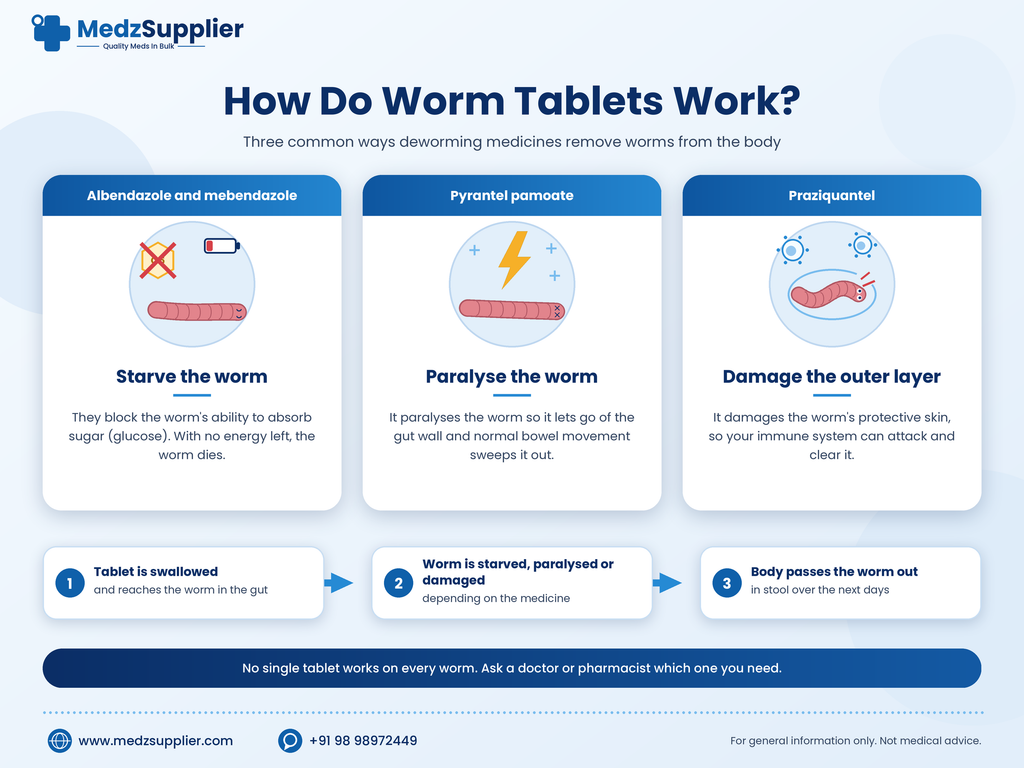
Different tablets work differently. Albendazole and mebendazole block the worm’s ability to absorb sugar (glucose), so it loses energy and dies. Pyrantel paralyzes the worm so the gut can sweep it out. Praziquantel damages the worm’s outer layer so the immune system can attack it.
Fenbendazole: What It Is and Why It Is Not a Human Worm Tablet
Fenbendazole is a worm medicine made for animals, not people. It belongs to the same benzimidazole family as albendazole and mebendazole, and it is widely used to deworm dogs, cattle, goats, and horses. Veterinary brands include Panacur.
Because it is so similar to the human medicines, many people ask whether fenbendazole can be used as a worm tablet for humans. The honest answer is no. The American Cancer Society reports that the US FDA has never approved fenbendazole for people for any purpose, and that it has not been tested in human studies. There is no proven human dose, no reliable data on drug interactions, and no safety data for children, pregnant women, or people with liver disease.
Albendazole and mebendazole went through years of human testing before doctors began prescribing them. Fenbendazole did not. A close chemical relative is not the same thing as a safe medicine.
| Medicine | Made for | Human approval | Typical use |
| Albendazole | Humans | Approved in many countries | Roundworm, hookworm, whipworm, some tapeworms |
| Mebendazole | Humans | Approved in many countries | Pinworm, roundworm, whipworm, hookworm |
| Fenbendazole | Animals | Not approved by the US FDA | Deworming dogs, cattle, goats, horses |
If you think you have worms, see a doctor or pharmacist and ask for a medicine that is made and licensed for people. Do not take pet or farm-animal products, even in a smaller dose.
Fenbendazole and Cancer Claims: What the Evidence Shows
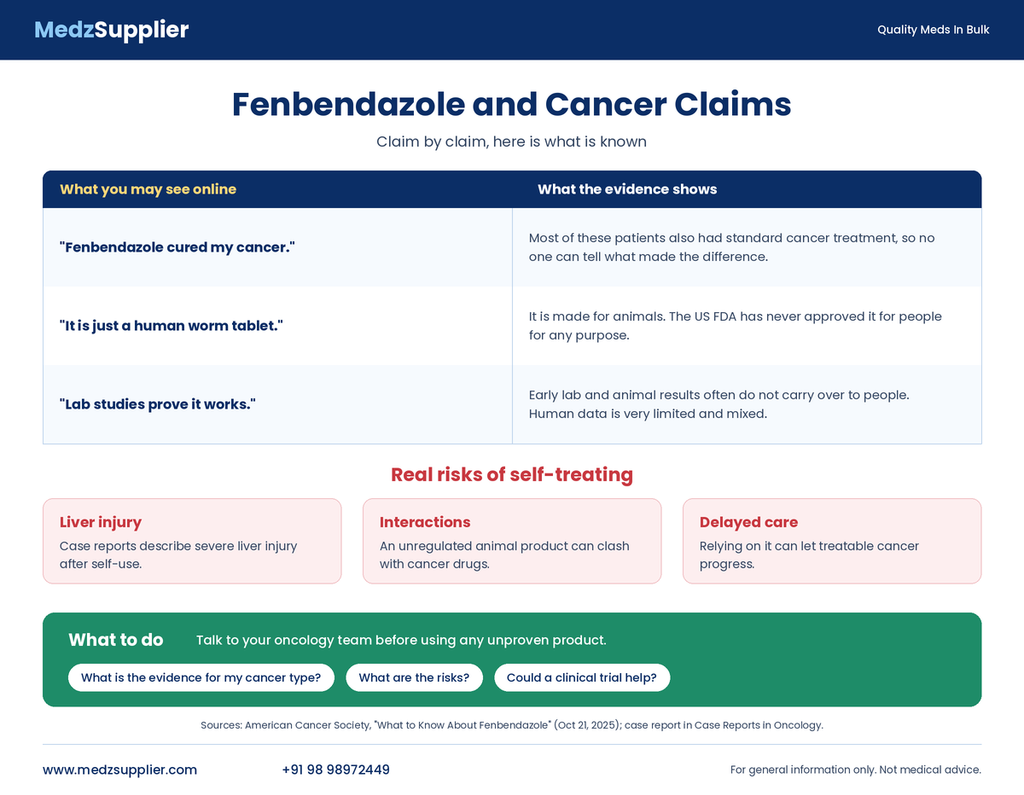
Fenbendazole is not a proven cancer treatment, and it should not replace medical care. It has spread online through personal stories from people who say it helped their cancer. Those stories are not evidence. According to the American Cancer Society, most of those patients also had standard cancer treatment at the same time, so nobody can tell which one made the difference. One widely shared case involved a man with lung cancer who was also enrolled in a study of an approved immunotherapy.
What research exists is early. Laboratory studies of fenbendazole and related drugs have shown some activity against cancer cells in dishes and in animals. Results like that often do not carry over to people, and the same source describes the human data as very limited and mixed.
The risks are real:
- Liver injury. A published case report describes a woman with advanced lung cancer who took fenbendazole after reading about it on social media. She developed severe liver injury, and her liver function improved after she stopped.
- Interactions. An unregulated animal product can interfere with prescribed cancer drugs or make side effects harder to sort out.
- Delayed care. Relying on an unproven product can let a treatable disease progress.
If you or someone you love has cancer and is thinking about fenbendazole or any other supplement, talk to the oncology team first. Ask what evidence exists for your type of cancer, what the risks are, and whether a clinical trial could be an option. This guide does not recommend fenbendazole for cancer, worms, or any other condition in humans.
How to Take Worm Tablets Safely
- Get a diagnosis first when possible. A stool test can confirm the worm type.
- Follow the label or your doctor’s instructions exactly. Dose depends on the medicine, age, and weight.
- Treat the household if advised. Pinworm spreads easily, so doctors often recommend treating everyone at home.
- Repeat only if told to. Some infections need a second dose after two to three weeks.
- Wash bedding and clothes in hot water after treating pinworm.
Possible Side Effects
Side effects are usually mild and short-lived:
- Nausea or vomiting
- Stomach cramps
- Headache or dizziness
- Temporary diarrhoea
Contact a doctor right away if you develop a rash, swelling of the face or lips, difficulty breathing, severe abdominal pain, or yellowing of the skin or eyes.
Who Should Talk to a Doctor Before Taking Worm Tablets?
- Pregnant or breastfeeding women
- Children under two years old
- People with liver disease
- Anyone taking other regular medicines
- Anyone with a seizure disorder or a suspected brain infection from tapeworm
Worm Tablets for Children
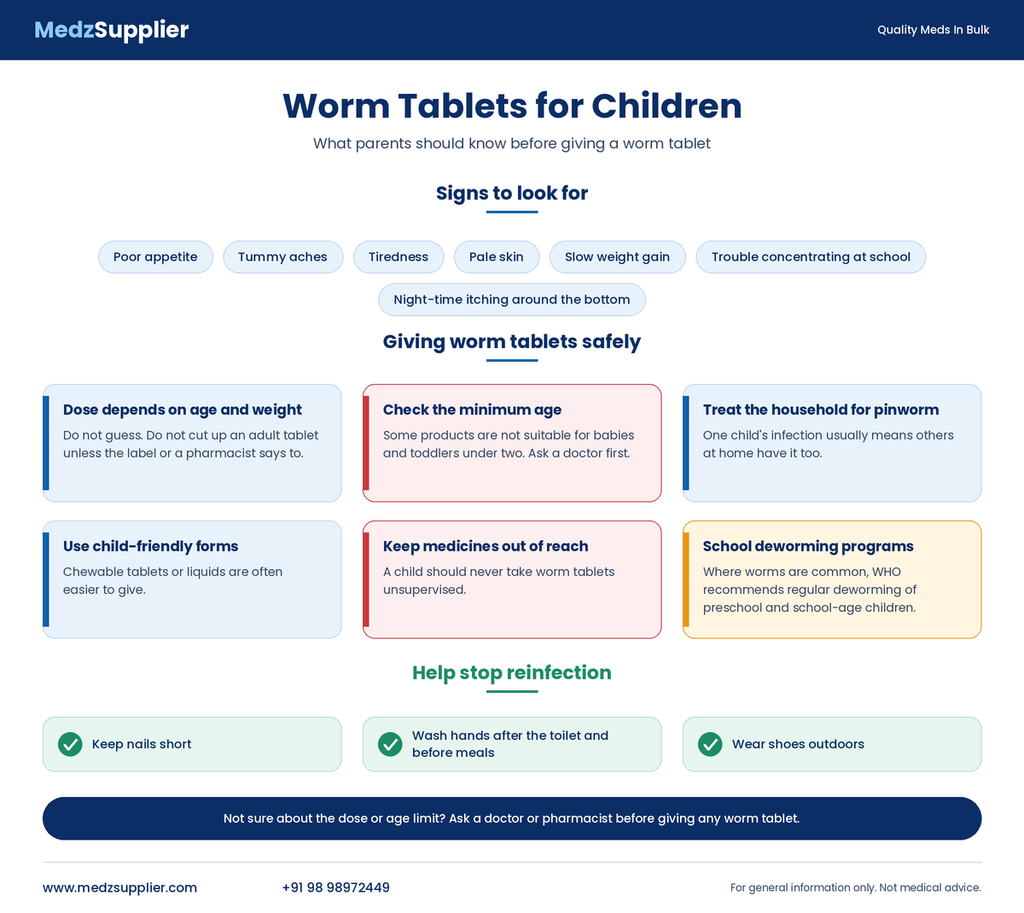
Children catch worms more often than adults, and the signs can be easy to miss. Look for a poor appetite, tummy aches, tiredness, pale skin, slow weight gain, trouble concentrating at school, or itching around the bottom at night.
Where worm infections are common, the World Health Organization recommends regular deworming of preschool and school-age children. That is why many countries run school-based programs that give a worm tablet once or twice a year.
If you are treating a child yourself, keep these points in mind:
- Dose depends on age, weight, and the product. Do not guess, and do not cut up an adult tablet unless the label or a pharmacist says to.
- Check the minimum age. Some products are not suitable for babies and toddlers under two. Ask a doctor first for any child that young.
- Treat the household for pinworm. One child’s infection usually means others have it too.
- Use child-friendly forms. Chewable tablets or liquids are often easier to give.
- Keep medicines out of reach. A child should never take worm tablets unsupervised.
Alongside treatment, keep nails short, wash hands after the toilet and before meals, and have children wear shoes outdoors. These habits lower the chance of reinfection more than any tablet can.
Worm Tablets During Pregnancy and Breastfeeding
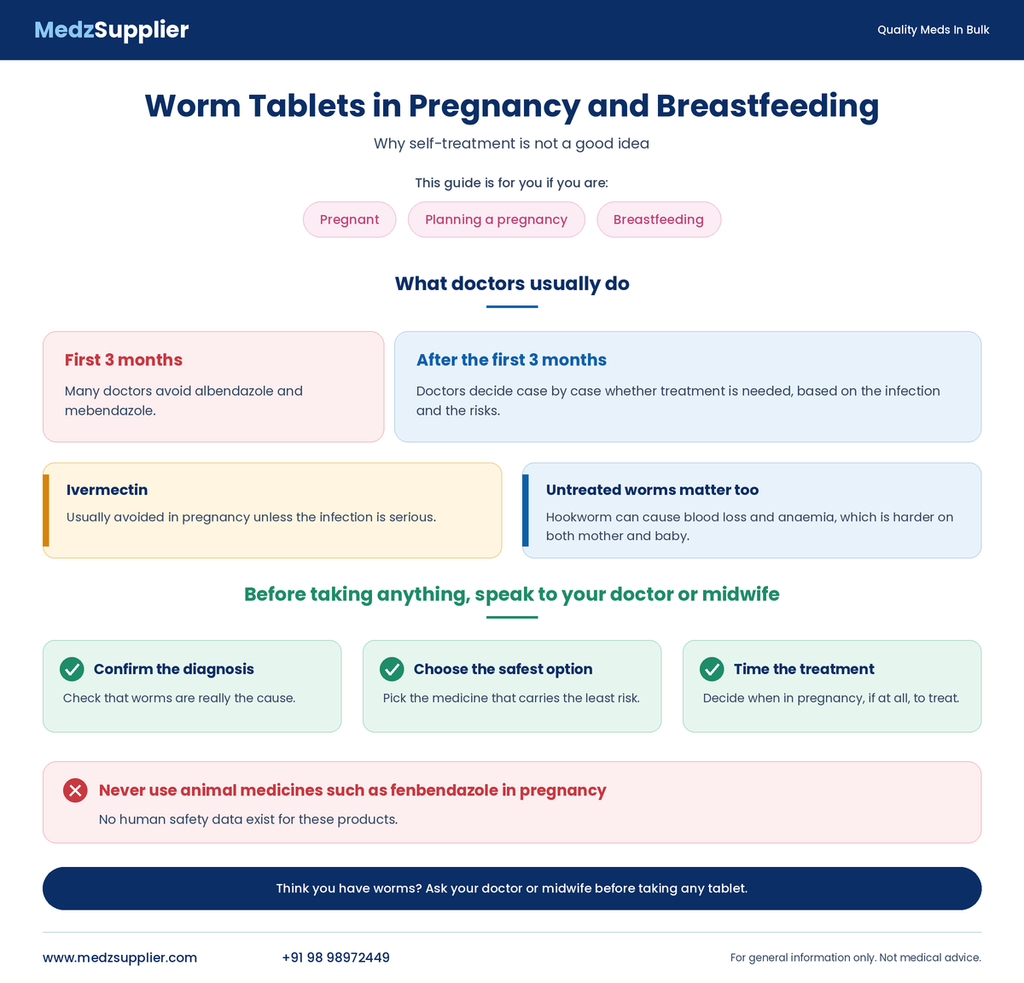
Pregnancy changes the balance between risk and benefit, so self-treatment is not a good idea. Many doctors avoid albendazole and mebendazole in the first three months of pregnancy and decide later, case by case, whether treatment is needed. Ivermectin is also usually avoided unless the infection is serious.
Untreated worms can matter too. Hookworm, for instance, can cause blood loss and anaemia, which is harder on both mother and baby. If you are pregnant, planning a pregnancy, or breastfeeding and think you have worms, speak to your doctor or midwife before taking anything. They can confirm the diagnosis, choose the safest option, and time the treatment. Never use animal medicines such as fenbendazole in pregnancy, because no human safety data exist.
Can I Give Human Worm Tablets to My Pet (or Vice Versa)?
No. Human and veterinary worm tablets have different ingredients and doses. Using the wrong one can be dangerous. Ask a vet for pet dewormers.
This is where fenbendazole causes confusion. Pet shops and farm suppliers sell it for dogs, horses, and livestock, and some people assume a lower dose is fine for themselves. It is not. Animal products are made and tested for animals, and their strength, ingredients, and purity are not checked for human use.
The risk runs the other way as well. A pet should not be given human worm tablets unless a vet says so, because dose and safety differ by species and body weight. Pets can also pass some worms to people, and roundworm in dogs and cats is the usual example, so regular vet-advised deworming of pets protects the whole household. Wash hands after handling pets or cleaning up after them, and keep children’s sandpits covered.
How to Prevent Worm Infections
- Wash hands with soap after using the toilet and before eating
- Wear footwear outdoors
- Wash fruit and vegetables well
- Drink safe, clean water
- Cook meat and fish thoroughly
- Keep children’s nails short and clean
- Follow local public deworming programs (many countries run school-based programs once or twice a year)
Home Remedies for Worms: What Helps and What Does Not
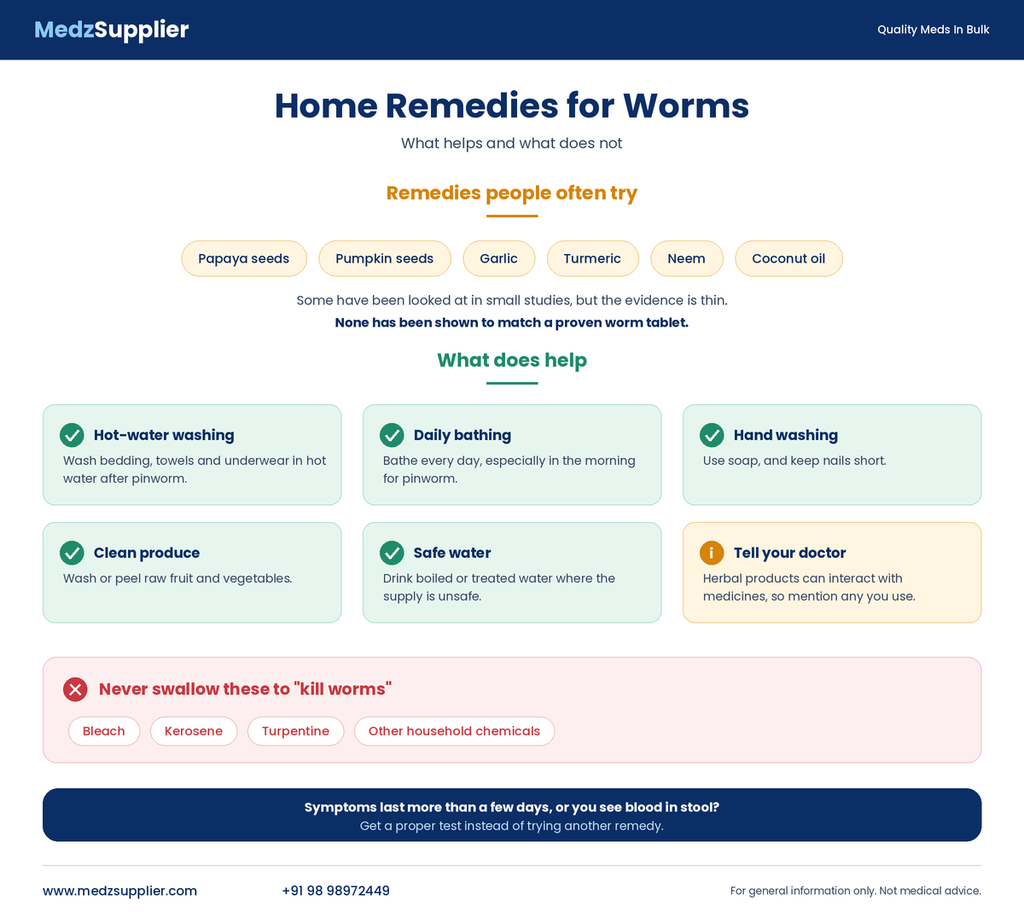
Searches for natural worm remedies are common, and the claims are often loud. Papaya seeds, pumpkin seeds, garlic, turmeric, neem, and coconut oil are the usual suggestions. Some have been looked at in small studies, but the evidence is thin, and none has been shown to match a proven worm tablet.
What does help is anything that cuts reinfection:
- Hot-water washing of bedding, towels, and underwear after pinworm
- Daily bathing, especially in the morning for pinworm
- Hand washing with soap, with nails kept short
- Washing or peeling raw fruit and vegetables
- Drinking boiled or treated water where the supply is unsafe
Be careful with remedies that can harm. Never swallow bleach, kerosene, turpentine, or other household chemicals to “kill worms”. Herbal products can also interact with medicines, so tell your doctor about any you use. If symptoms continue for more than a few days, or you see blood in stool, go for a proper test rather than trying another remedy.
How Often Should You Take Worm Tablets?
There is no single schedule that suits everyone. For a confirmed infection, one dose or a short course is usual, sometimes repeated after two to three weeks. For prevention, it depends on where you live.
The World Health Organization recommends regular, mass deworming of at-risk groups where worms are common: once a year where 20% or more of people are infected, and twice a year where 50% or more are. Programs such as India’s National Deworming Day, held twice a year, work this way. If your child’s school offers one, it is generally safe and worthwhile to take part.
Outside those programs, taking worm tablets every few months “just in case” is not recommended. It exposes you to side effects without a clear benefit, and it does not stop reinfection.
Common mistakes to avoid
- Taking a tablet without knowing which worm you have
- Stopping the course early because symptoms improve
- Treating one person when the whole household is exposed
- Skipping the repeat dose when a doctor advised one
- Using pet or farm-animal products, including fenbendazole
- Ignoring hygiene, which is how reinfection happens
When to See a Doctor
See a doctor if symptoms last more than a few days, if a child is losing weight or looks very pale, if you see blood in stool, or if symptoms return after treatment.
Frequently Asked Questions
What are worm tablets used for? They treat infections from intestinal parasites such as roundworm, hookworm, whipworm, pinworm, and tapeworm.
How long do worm tablets take to work? They begin working within hours, but itching and other symptoms may take several days to settle.
Can I buy worm tablets without a prescription? Some, such as mebendazole or pyrantel for pinworm, are sold over the counter in many countries. Rules vary, so check with a pharmacist.
How often should adults take worm tablets? Only when needed, or as advised by a doctor or a public health program. Routine self-dosing without a reason is not recommended.
Are worm tablets safe for children? Many are, but dose depends on age and weight, and some are not suitable under age two. Always follow the product label or a doctor’s advice.
Can worms come back after treatment? Yes. Reinfection is common if hygiene and sanitation do not change, which is why prevention matters as much as the tablet.
Can humans take fenbendazole? No. Fenbendazole is made and licensed for animals. The US FDA has never approved it for human use, and there are no human safety studies to set a safe dose. Ask a doctor for a worm tablet that is approved for people.
Is fenbendazole the same as albendazole or mebendazole? They belong to the same drug family and work in a similar way against worms, but they are different medicines. Albendazole and mebendazole are approved for humans. Fenbendazole is not.
Does fenbendazole cure cancer? No. It has not been proven to treat or cure cancer in people. Early laboratory findings and online stories are not the same as clinical trial results. Talk to an oncology team before using any unproven product.
What is the difference between albendazole and mebendazole? Both treat common intestinal worms. Albendazole is often used for hookworm, roundworm, whipworm, and some tapeworm infections, while mebendazole is a common choice for pinworm. A doctor or pharmacist can say which suits you.
Do worm tablets work on all worms? No. Each medicine covers certain worms. Tapeworm and fluke infections usually need praziquantel, and threadworm often needs ivermectin.
Should the whole family take worm tablets together? For pinworm, doctors often advise treating everyone in the household at the same time. For other worms, treatment depends on who is infected or exposed, so ask your doctor.
Can I drink alcohol while taking worm tablets? It is best to follow the leaflet for your specific medicine and ask a pharmacist. Alcohol can add to nausea or dizziness, and it is worth avoiding if your liver is already under strain.
Supplier Information
Supplier: MedzSupplier
Wholesale: [medzsupplier]
Manufacturer: [medzsupplier]
Worm tablets listed through MedzSupplier should be medicines that are licensed for human use in your country.
Check the manufacturer name, batch number, and expiry date on every pack before use.
Where the law requires a prescription, order only with a valid one.
If you are unsure about the dose or whether a tablet suits you or your child, ask a doctor or pharmacist first.
For wholesale or bulk enquiries, contact: Medzsupplier
Regulators: WHO (World Health Organization), the US FDA (Food and Drug Administration), and the TGA (Therapeutic Goods Administration, Australia)
Approval status depends on the specific medicine and the country. You can check each product yourself in the regulator’s own records: Drugs@FDA for the US FDA, the ARTG (Australian Register of Therapeutic Goods) for the TGA, and the WHO list of prequalified medicines.
Order Worm Tablets Through MedzSupplier
Looking for worm tablets online? MedzSupplier makes it simple to order deworming medicines such as albendazole and mebendazole from the comfort of your home.
MedzSupplier works as a wholesaler, supplier, and exporter of worm tablets, delivering to customers in different countries. Our team aims to follow the pharmacy rules and guidelines of each country we ship to.
We have years of experience serving customers. Our prices are affordable, and you can order worm tablets online or ask about wholesale supply by visiting our official website.
Always check that a tablet is licensed for human use in your country, and ask a doctor or pharmacist if you are unsure about the dose.
Medical disclaimer: This article is for general information and does not replace advice from a qualified healthcare professional.
Sources for the fenbendazole sections: What to Know About Fenbendazole, American Cancer Society (October 21, 2025); Drug-induced liver injury after self-administration of fenbendazole, case report in Case Reports in Oncology.